
Exam area
- Incident Response -12%
- Trusted Advisor, CloudFormation, Service Catalog, VPC Flow Logs, AWS Config, API gateway, CloudTrail, CloudWatch.
- Logging and Monitoring - 20%
- CloudWatch, Config, CloudTrail, Inspector, Kinesis.
- Infrastructure Security -26%
- Route53, WAF, CloudFront, Shield,
- IAM -20%
- Data Protection -22%
S3
- Glacier vault lock, vault lock policy, WORM(write once, read many times). Once locked, the policy can no longer be changed.
- VPC gateway endpoint-> DynamoDB and S3
- VPC interface endpoint -> other aws services.
- Object ACLs, give grants to bucket owner, grant access to individual objects.
- Bucket ACLS, grant log delivery group write permission to bucket.
- Bucket policies, offer larger permissions than bucket ACLs.
- S3 server-side encryption is used to protect data at rest.
- Server access logging, provides detailed records for the requests that are made to a bucket
- If bucket version is enabled, each object version should have a different encryption key.
- s3 bucket can set aws:referer key to get request originate from specific webpages.
interface endpoint vs gateway endpoint
- An interface endpoint is powered by PrivateLink, and uses an elastic network interface (ENI) as an entry point for traffic destined to the service.
- A gateway endpoint serves as a target for a route in your route table for traffic destined for the service, only for s3 and DynamoDB.
CloudFront
- Access logs for source IP address, the original request, the referrer, and protocol information.
ACM
- There is no ACM private CA policy, can use IAM polices(users,groups,roles) to control access.
- ACM is regional service, for redundancy you need to create multiple CAs.(Not matter private CA or public CA)
- AssumeRoleWithWebIdentity, STS temporary security credentials returned by this API consist of an access key ID, a secret access key, and a security token.
ALB
- Supports multiple TLS certificates via (server name indication)SNI.
STS
- Federation(typically Active Directory)
- SAML
- SSO allows users to log in without IAM credentials
- Federation with Mobile Apps
- Facebook/Amazon/Google or other OpenID providers to log in.
- No need to store AWS credentials locally
- Provide temporary credentials map to an IAM role
- Cross Account Access
- GetFederationToken returns a set of temporary security credentials (consisting of an access key ID, a secret access key, and a security token) for a federated user.
Cognito
- Used for authenticating to web and mobile applications and is not related to Microsoft AD.
- User Pools, user directories, creating users or federating to social IdPs
- Identity Pools, support anonymous guest users or unauthenticated access.
Identity providers and federation
- Use IAM OpenID Connect(OIDC) When establish trust between an OIDC-compatible IdP and AWS account but cannot manage users. For mobile app or web app.
- Use IAM identity provider when establish trust between SAML-compatible IdP(ADFS and aws), that users in your org can access aws.
IAM
- trust policy, a required resource-based policy that is attached to a role in IAM. The principles that you can specify in the trust policy include users, roles, accounts, and services.
- IAM Access Analyzer, helps you identify the resources in your organization and accounts, such as Amazon S3 buckets or IAM roles, shared with an external entity. This lets you identify unintended access to your resources and data.
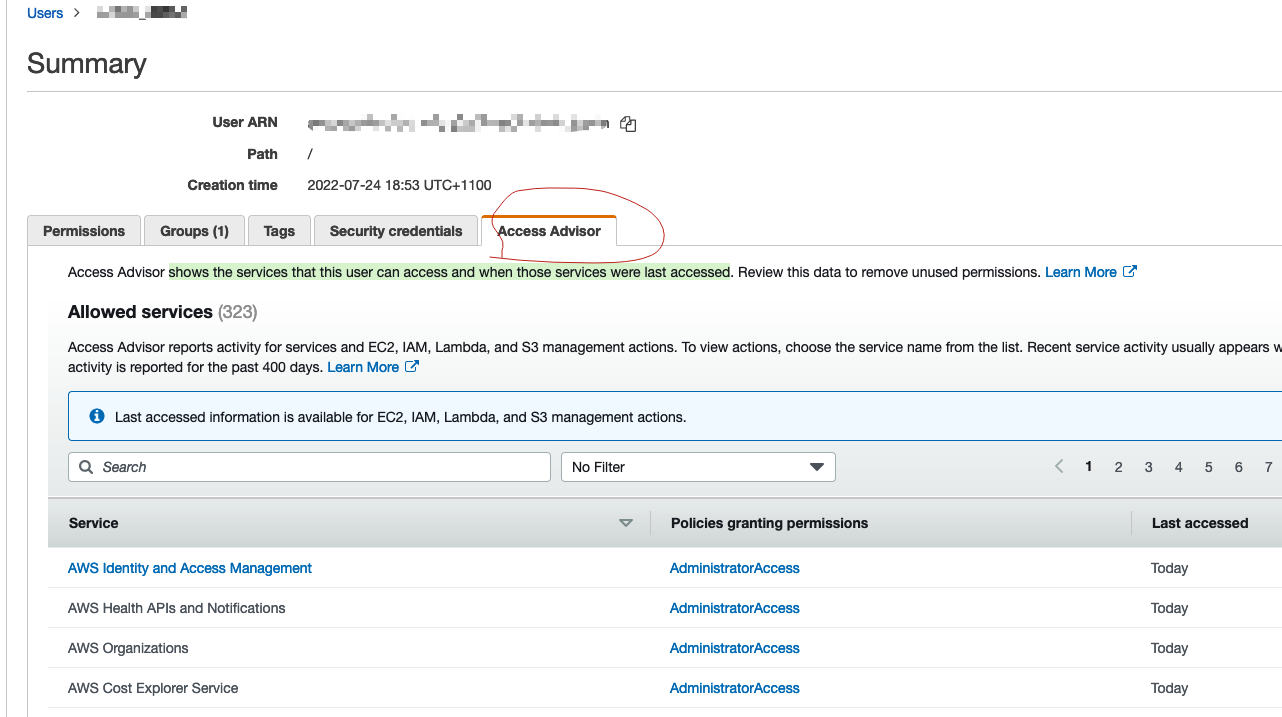
- IAM Access advisor, shows the services that this user can access and when those services were last accessed
- IAM credential report, list all users and the status of their various credentials, passwords, access keys, MFA.

AWS Resource Access Manager
- sharing your AWS resources with other accounts
Logging and Monitoring
Cloudtrail
- log file integrity, delivered with a digest file.
- does not use an IAM Role it uses the service principal
“cloudtrail.amazonaws.com". - Event history,-90days
Cloud config
- detect resources changes, not compromised access, not usage.
- Auto Remediation feature automatically remediates non-compliant resources evaluated by AWS Config rules.
- Provides a detailed list of resources defined in your aws account.
- Can add custom rules using Lambda functions.
- Trigger frequency is 1,3,6,12,24 hours.
CloudHSM
- single tenancy, secure key store, cryptographic operations, tamper-resistant hardware security module
- should be used if you need hardware based HSMs within a VPC.
- CloudHSM cluster, can inlude many HSM instances in different AZs.
AWS inspector
- CIS benchmarks/ certified rules, automated security, vulnerabilities assessment service
- tests the network accessibility of your EC2 instances and the security state of your applications that run on those instances.
Trust advisor
- provides recommendations that help you follow AWS best practices. Trusted Advisor evaluates your account by using checks. These checks identify ways to optimize your AWS infrastructure, improve security and performance, reduce costs, and monitor service quotas.
- can provide information on security groups for any sort of unrestricted access.
Infrastructure security
KMS
- key deletion time min 7 days
- KMS keys can only encrypt data up to 4 KB in size and for anything larger you need to create data encryption keys.
- Key rotation:
- AWS managed KMS, YOU CAN DO Nothing, even add key, automatically rotates every year.
- Customer Managed KMS, automatic rotation every 365 days(disabled by default), can rotate manually; create new CMK or change Key Alias to new CMK.
- Customer managed + imported key material, no automatic rotation, create new CMK or change Key Alias to new CMK.
- change expiration date of a KMS key,=> reimport same key material and specify a new expiration date.
- Kms:ViaService, used for ec2/RDS from Us-west region
- custom key store is backed by AWS CloudHSM and imposes certain limitations. For example you cannot import your own key material into KMS keys or enable automatic rotation
- cryptographic erasure, is when the encryption material used to encrypt the data is deleted. ensure that the key materials are backed up offline(import key material into an AWS KMS key) so you can perform a restore of the data.
System manager
- patch manager, can be used to scan systems, report compliance 生成报告, identify vulnerable versions of software and then install the patches on the systems
- systems Manager automation can be configured for automatic remediation if the rule returns a non-compliant state.
- systems Manager Compliance is used to scan instances for patch compliance and configuration inconsistencies. It is not used to monitor access policies of S3 buckets.
- Run command, allows you to automate common administrative tasks and perform one-time configuration changes at scale, eg reset passwords(AWSSupport-RunEC2RescueForWindowsTool).
- EC2Rescue, a troubleshooting tool that you can run on your Amazon EC2 Windows Server instances. collect memory dumps from EC2 instances that are unresponsive using the EC2Rescue CLI with the /offline mode and the device ID specified.
Macie
- machine learning to discover, classify and protect PII in S3/cloudtrail
- Includes Dashboards, reports and alerting
GuardDuty
- threat detection service provides an accurate and easy way to continuously monitor and protect AWS accounts and workloads.
- can detect attacks such as application-level attacks. However, to offer the protection you would need to integrate with other services such as CloudWatch Events and Lambda to respond to incidents.
- Findings, Malicious and unauthorized behaviour(resource affected, action ), such as port scans.
QuickSight
- For Visualization, and only supports text file formats(.csv,.tsv .clf or .elf) stored in S3.
QuickSigh
Security Hub
- central hub for security alerts
- automated checks
- PCI-DSS(payment card industry)
- CIS(center for internet security)
- Integration(guardduty, macie, inspector, firewall manager)
Artifact
- central resource for compliance and security-related information
- ISO, PCI, SOC reports, validate compliance of underlying aws infrastructure.
DDos mitigation on AWS
- ELB, CloudWatch, ASG, Shield, Route53, WAF and CloudFront.
CloudWatch
- Unified CloudWatch Agent sends system-level(memory and disk usage) metrics for EC2 and on- premises servers.
AWS signer
- only trusted code runs in your Lambda functions, create digitally signed packages for Lambda deployment.
VPC
- Flow Logs, can be used to capture IP traffic.
- VPC Traffic Mirroring, use to copy network traffic from an elastic network interface of Amazon EC2 instances. You can then send the traffic to out-of-band security and monitoring appliances for: Content inspection, Threat monitoring and Troubleshooting
- All traffic sent to EC2 instances can be captured for inspection with an intrusion detection appliance by configuring VPC traffic mirroring with a network load balancer.
- Each EC2 instance performs source/destination checks by default. This means that the instance must be the source or destination of any traffic it sends or receives. However, an inline security appliance/a NAT instance must be able to send and receive traffic when the source or destination is not itself.
- The public keys are in the .ssh/authorized_keys file on the instance. To replace the key pair, generate a new key pair using the EC2 console and then paste the public key information into the authorized_keys file. The original key information should also be deleted.
Organization trails
- log events for the management account and all member accounts in the organization.
- When you create an organization trail, a trail with the name that you give it will be created in every AWS account that belongs to your organization. Users with CloudTrail permissions in member accounts will be able to see this trail when they log into the AWS CloudTrail console from their AWS accounts, or when they run AWS CLI commands such as describe-trail.
- However, users in member accounts will not have sufficient permissions to delete the organization trail, turn logging on or off, change what types of events are logged
Amazon Detective
- automatically collects log data from your AWS resources. It then uses machine learning, statistical analysis, and graph theory to generate visualizations that help you to conduct faster and more efficient security investigations.
- When you try to enable Detective, Detective checks whether GuardDuty has been enabled for your account for at least 48 hours. If you are not a GuardDuty customer or have been a GuardDuty customer for less than 48 hours, you cannot enable Detective. You must either enable GuardDuty or wait for 48 hours. This allows GuardDuty to assess the data volume that your account produces.
OpenSearch
- successor to Elasticsearch and is a distributed, open-source search and analytics suite used for a broad set of use cases like real-time application monitoring, log analytics, and website search.
- receive data from Kinesis and can then analyze and store the data.
Secrets Manager vs Parameter Store
- For Secrets Manager, PCI compliant where the mandate is to rotate your passwords every 90days. Only works for select databases and does not work for SSH keys
- For Parameter Store, a cheaper option to store encrypted or unencrypted secrets, does not automatically rotate credentials
AWS Audit Manager
- map your compliance requirements to AWS usage data with prebuilt and custom frameworks and automated evidence collection.
AWS Firewall Manager
- Works with WAF, Network Firewall, Shield, Route53 Resolver DNS Firewall.
- network access control list (NACLs) is an optional layer of security for your VPC or subnet level that acts as a firewall for controlling traffic in and out of one or more subnets, while sg for instances.
Network Firewall
- intrusion detection and prevention service for your virtual private cloud (VPC)
- can filter traffic
Kinesis
- Log ingestion
- Kinesis data streams
- Basic(stream-level), automatically per minute no charge
- Enhanced(shared-level), per minute with extra cost.
- Producer(DescribeStream, PutRecord) and Consumer(GetStream, GetRecords)
- Kinesis Data firehose
- Kinesis data streams
- Log analysis
- Kinesis data analytics
AWS Directory Service
- AWS Managed Microsoft AD - AWS Cloud, for up to 5000 employees and directory objects.
- AD Connector - On-premises users need to access AWS services via AD.
- Simple AD - Low-scale, low-cost basic Active Directory capability.
Others
Direct Connect + Virtual private gateway(VGW)=encryption in transit( IPsec-encrypted private connection)
Kinesis Data Streams uses TLS for all connections, so the data is encrypted in transit by default.
Forward Secrecy (FS) uses a derived session key to provide additional safeguards against the eavesdropping of encrypted data. This prevents the decoding of captured data, even if the secret long-term key is compromised. ALB does not support custom security policies.
Envelope encryption, encrypt plaintext data with a data key, and then encrypting the data key under another key.
Key pairs consist of a public key and a private key. Private key to create digital signature, public to validate signature. Key pairs can be used to SSH to aws EC2 instances.
AppSync enables subscriptions to synchronize data across devices.
A Lambda function can be cofigured to connect to DynamoDB using private IPs by cofiguring the function in a VPC and using a VPC endpoint for the DynamoDB table.
All data flowing across AWS Regions over the AWS global network is automatically encrypted at the physical layer before it leaves AWS secured facilities. All traffic between AZs is also encrypted.
organization trail, you can create a trail that logs all events for all AWS accounts in that organization
Lambda authorizer, uses a bearer token authentication strategy such as OAuth or SAML, or that uses request parameters to determine the caller’s identity. When a client makes a request to one of your API’s methods, API Gateway calls your Lambda authorizer, which takes the caller’s identity as input and returns an IAM policy as output.
Refer: https://learn.acloud.guru/course/aws-certified-security-specialty/dashboard