AWS Certified SysOps Administrator Associate notes

Route53
- A record - root domain, forward domain/sub domain to IPv4 address
- Alias - route traffic to AWS resources, such as CloudFront, S3.
- CNAME - map one domain to another, but not root domain.
- AAAA - IPv6
CloudFormation
- StackSets - can deploy to multiple accounts/regions with single operation
- Changeset - upcoming changes
- Nested stacks - reuse
encryption
- SSE-S3, s3 managed keys + AES 256
- SSE-KMS, key can be customer generated and KMS managed
- SSE-C, server side encryption + client manage keys + key does not store on AWS
- Client side encryption
Volume and Storage
- Volume gateway
1. Stored volumes, synchronize copy ->s3, full volume to local gateway
2. Cached Volumes, full volume ->s3, part volume to local cache. - File Gateway(NFS, SMB)
- SSD
1. General purpose, gp3, gp2
2. Provisioned IOPS, io2(block express), io1 - HDD(cannot use as boot volume and multi attach)
1. Throughout optimized, st1
2. Cold HDD, sc1 - RDS
1. Enhanced monitoring, metrics, cpu, memory, cheaper visibility
2. Proxy pool share DB connections, improve performance.
3. Multi-AZ, high availability. - S3
1. RTC(Replication time control), event notification <15mins
2. WORM, vault lock policy
3. Inventory report, audit/report replication/encryption status of objects.
vs System manager inventory, collect metadata from EC2 and on prem.
4. Transfer Acceleration is a bucket-level feature that enables fast, easy, and secure transfers of files over long distances between your client and an S3 bucket.
5. Global Accelerator service does not work with S3. It only supports endpoints like application load balancers, network load balancers, EC2 instances, or elastic IP addresses. - Data Lifecycle Manager
1. automate the creation, retention, and deletion of Amazon Elastic Block Store (Amazon EBS) snapshots.
2. create a lifecycle policy that includes specific tags to back up EBS volumes on a specified schedule and for a specified retention period. - Aurora DB cluster,
- consists of one or more DB instances and a cluster volume that manages the data for those DB instances
- cluster volume is a virtual database storage volume that spans multiple Availability Zones, with each Availability Zone having a copy of the DB cluster data.
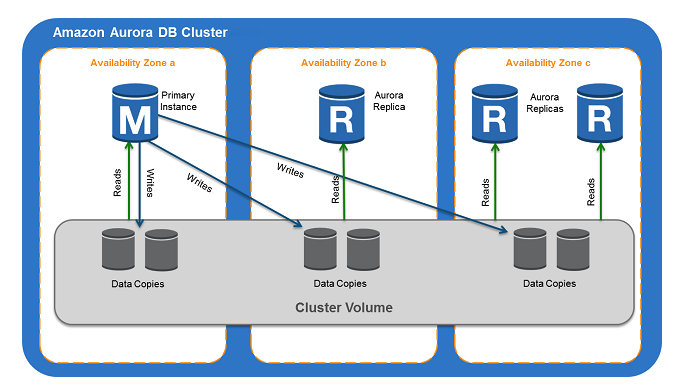
Link https://docs.aws.amazon.com/AmazonRDS/latest/AuroraUserGuide/Aurora.Overview.html
- backtracking an Aurora DB cluster,”rewinds” the DB cluster to the time you specify
- the Performance Insights feature in the Amazon Aurora Serverless database which will automatically connect to a new Aurora database instance while preserving application connections.
AD
- AWS AD, windows, VPN/ direct connect
- AD connector, trust relationship, AD->AWS
- Simple AD, LDAP
AMI
- Linux parasitical AMI, are not supported in all AWS regions.
- Hardware VM(HVM)
ElasticCache(in-memory data store)
Redis, add shards, scales horizontally, support data types
- cluster mode enabled, means that your data and read/write access to that data is spread across multiple Redis nodes.
- richer data types and operations, great for leaderboard, geospatial data
Memcached, multithread, add nodes, scaled vertically
- key/value store faster than Redis
- Scaling HORIZONTALLY:
1.1. scale out (Add Nodes to a Cluster)
1.2. scale in (Remove Nodes from a Cluster) - Scaling VERTICALLY
2.1 scale out (create a new cluster and using a higher EC2 type)
2.1 scale in (create a new cluster and using a lower EC2 type) - does not support Multi-AZ for high availability.
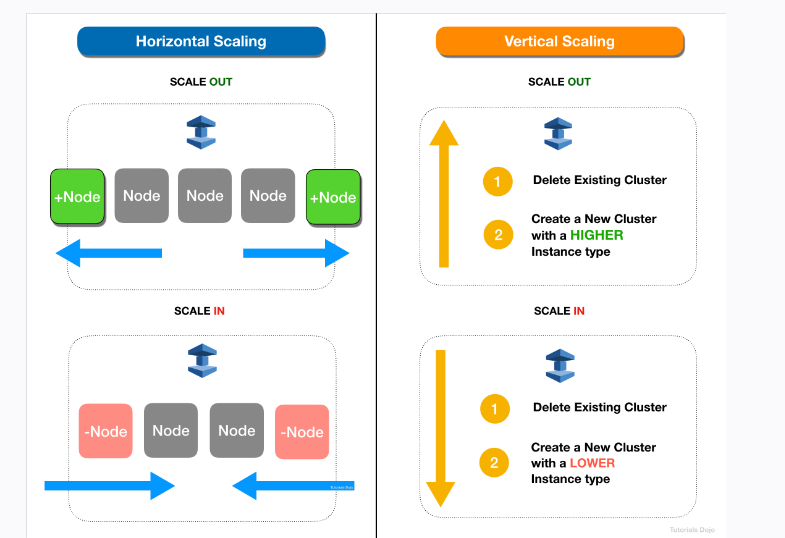
From link https://portal.tutorialsdojo.com/courses/aws-certified-sysops-administrator-associate-practice-exams/
Some security and other services
- WAF, SQL Injection/ Cross site scripting, filter web traffic based on IP addresses, HTTP body/headers, custom URIs
- OpsHubs, manage snow family, devices and local aws services
- OpsWorks, chef and puppet
- Control tower,create accounts via account factory, enroll account, landing zone’s managment accounts.
- Artifact, report of ISO certificates and PCI.
- cloudHSM, hardware security module, 3rd party support, generated encryption keys
- Config,
- Shield, DDOS
- Shield Advanced: DDOS protecting for scaling, layer3,4 and 7
- Inspector, automated vulnerability management service that continually scans workloads for software vulnerabilities and unintended network exposure.
- GuardDuty, Intelligent threat detection.
- Cloudtrail, who to blame, log API activity, data events and file integrity validation.
- X-Ray, debug apps
- Macie, machine learning to discover, monitor and protect s3. API keys, regulatory documents.
- Glue, extract, transform, load (ETL) service, work with data lakes,redshift,RDS,crawler to populate glue catalog with tables.
- Trust Advisor, check service usage>80%, real time guidance, cost
- Cost Explorer, view costs, usage and forecast.
VPC and Network
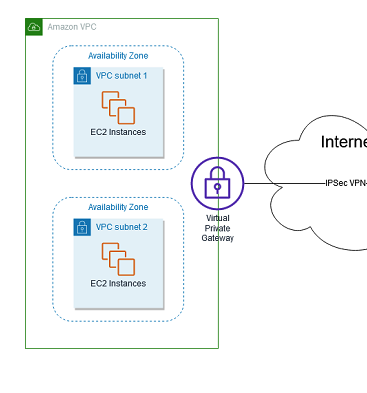
- Direct connect + VPN = IPSec-encrypted private connection
- Site to site VPN = on prem + amazon VPC
- Route table and NACLs, stateless - VPC level
- Security group-> stateful, subnet level
Others never remembered
- Enhanced Networking, provides higher bandwidth, higher packet per second (PPS) performance, and consistently lower inter-instance latencies
- Virtual Private Gateway,VPN endpoint
- CloudFront Origin Shield, an additional layer in the CloudFront caching infrastructure that helps to minimize your origin’s load, improve its availability, and reduce its operating costs.缓存Better cache hit ratio,Better network performance and Reduced origin load.
- warm pool is a pool of pre-initialized EC2 instances that sits alongside an Auto Scaling group
System manager
- Inventory, collects information about your instances and the software installed on them, helping you to understand your system configurations and installed applications.
- Automation, automate common and repetitive IT operations and management tasks
- Run Command, provides you safe, secure remote management of your instances at scale without logging into your servers, replacing the need for bastion hosts, SSH, or remote PowerShell
Cloudfront
- Edge locations and local zones
- Cache statistics,
- Popular objects, what objects are frequently being accessed, and get statistics on those objects.
- Top referrers
- Usage report, the number of HTTP and HTTPS requests that CloudFront responds to from edge locations in selected regions.
- Viewers, the physical devices (desktop computers, mobile devices) and about the viewers (typically web browsers)
Little
- By default, the enableDnsHostNames is set to false for VPCs created using the AWS CLI
- AWS Resource Access Manager (RAM) helps you securely share your resources across AWS accounts
- Step Function, provides serverless orchestration for modern applications.
- SWF,fully-managed state tracker and task coordinator service
ALB
- Connection draining, Auto Scaling will wait for outstanding requests to complete before terminating instances.
- ASG lifecycle hook, can be used to the auto-scaling group to pause an instance before it’s terminated. perform custom actions during ec2 instances scale-out or scale-in.
- EC2Rescue,a troubleshooting tool that you can run on your Amazon EC2 Windows Server instances.
IAM
- Identity based policy, attached to Identity(role, user and group)
- resource based policy, attached to resources and additional principal